From IVR to AI: The Evolution of Contact Center Automation
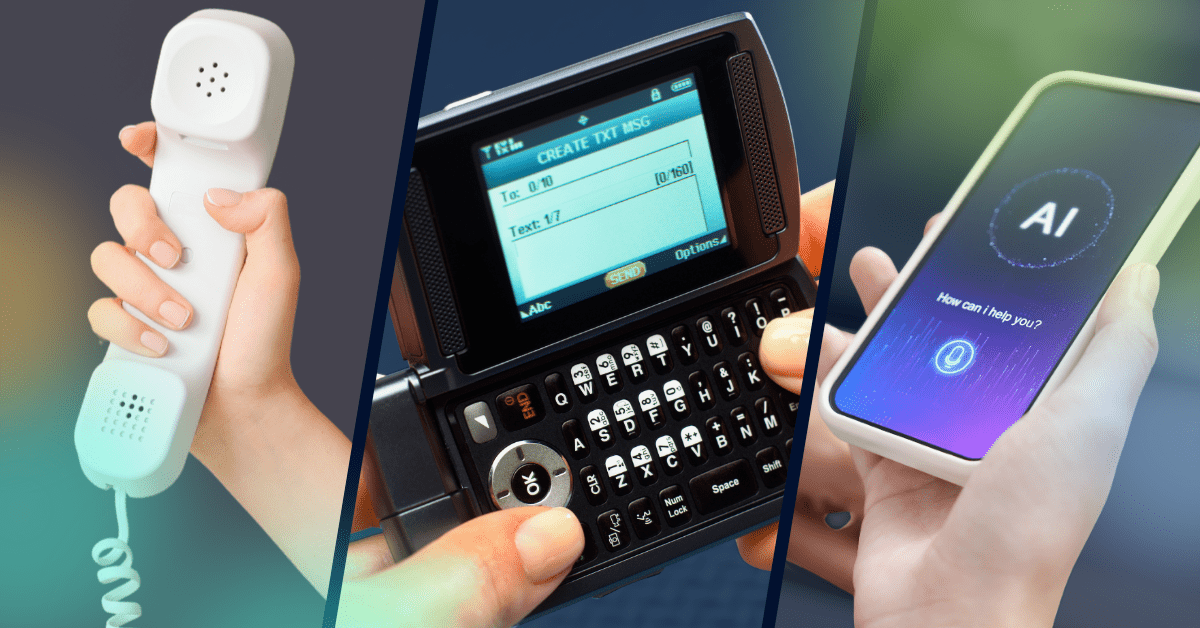
Wince a little? Then you know the story.
Contact center automation has always chased one goal. Handle more conversations with fewer people.
Three waves have tried. IVR, then IVA, now AI. And here’s the part nobody puts on the roadmap slide. The first two broke for the exact same two reasons.
Spot that pattern and you can dodge it this time. Miss it and you’ll buy a shinier version of the same headache.
Wave One: The Legacy IVR
The Interactive Voice Response system ran things from the 1990s into the 2010s. For its time, it was a leap. Touch-tone menus routed calls with no operator. Simple, scalable, cheap.
Then reality hit. IVRs couldn’t change. You built the menu tree once and rarely touched it again. Updating it was slow and expensive.
So customers got stuck. They pressed buttons through options that didn’t fit their problem. The industry gave it a name it never forgot: IVR jail.
The IVR could deflect volume. It couldn’t understand a thing.
Wave Two: The Cloud-Era IVA
The cloud brought the Intelligent Virtual Agent, or IVA. No more fixed menu. Now there were intent-driven call flows.
Add natural language processing and text-to-speech. Suddenly a customer could just say what they wanted. Big step up. IVAs handled simple requests and felt far less robotic.
But look closely and it’s the same story. Every intent still had to be mapped out in advance. So the system stayed hard to build and harder to maintain. Anything off the rails fell apart.
Better than IVR jail. Still a maze, just nicer walls.
The Two Reasons Both Waves Broke
Line them up and the failure pattern is obvious:
Can’t bend, can’t understand. Every frustrated caller, every abandoned chat, every “let me start over” traces back to those two. Keep them in mind. They’re your test for what comes next.
Wave Three: AI Agents and the Generative Era
Since 2022, large language models have rewritten the rules. AI agents generate answers on the fly. No script.
They handle multi-turn, multi-topic, multilingual chats in one conversation. A customer can change the subject, switch languages, and double back. The agent keeps up.
So the first two problems? Largely solved. It can bend now. And it actually understands.
But every wave brings something new to watch for, and this one’s subtle. Generative AI can be confidently wrong. It doesn’t stall like an IVR. It answers smoothly, clearly, and sometimes completely made up.
In a contact center full of sensitive data, a confident wrong answer is worse than no answer. That’s the trap to design around this time.
Five Questions to Ask Every AI Vendor
So you’re evaluating AI for your contact center. You’re in the demo, the slides look great, and it’s tempting to nod along. Don’t.
This is where you protect yourself. Put these five questions to every vendor before you sign. They’re what keeps wave three from becoming IVR jail in a nicer outfit:
Run any vendor through those five. The fluff falls away fast.
Volume Was Never the Hard Part
Every wave got better at handling volume. The ones that won did it without making customers feel abandoned.
That’s still the bar. Modern AI can carry way more of the load than any IVR or early IVA. Done right, the customer gets a human when it counts. And a solid answer the rest of the time.
Now you know what to watch for.
LinkLive weaves AI across a secure contact center platform that’s HITRUST r2-certified, so regulated teams can automate the volume and still keep a human within reach.

